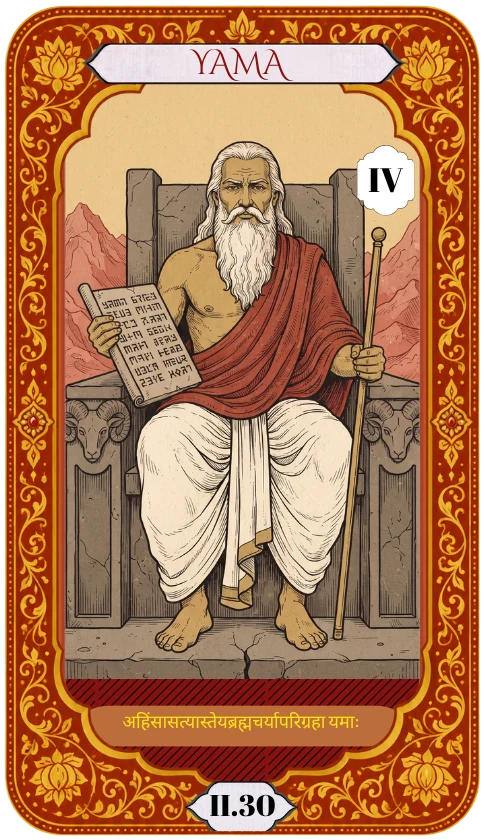
Yama (Universal Ethics II.30)
Major Arcanum: The Emperor
Yama (II.30) — the great vow that holds in any place and any time.
Give your life structure. Choose one of the five yamas today and practice it in every action.
What Yama is
Before any posture come five agreements, and their name is yama. The word carries the idea of a rein: what holds and steers. They are ahiṃsā, not harming; satya, truth; asteya, not taking what is not yours; brahmacarya, moderation; aparigraha, not hoarding. Not one of them mentions the body or the breath. All of them are about conduct, and they come first for a simple reason: the mat does not repair what your life knocks over.
In the sutra
The full list is at II.30, and the place it occupies matters: the yamas open the path of the eight limbs, ahead of posture and breath. They are commitments to the outside, not inner exercises. Patañjali does not present them as the law of one people or one period: they hold wherever the person is. The text sets them as the footing, and a house with no footing does not stand up because of the trim.
How it shows up
In the room, the yamas turn up in small things: arriving late and setting up in front of someone who was already there, saying the shoulder is fine so you do not have to hear a correction, taking the block that belonged to someone else. Satya comes in too: staying in the posture you are in, not the one you would like to describe afterwards.
Out in the world, look at an agreed time. You say nine, you arrive at twenty past, and half an hour of three people's lives was spent waiting. Calling that lateness is generous: it is asteya, taking what is not yours, and time cannot be handed back. The same goes for the "I'll return it later" that is now two months old.
Why this card
The Emperor sits on a stone throne, rams' heads on the arms and dry mountain behind him. He has a scepter, armor and no ornament. The image is about limit: he exists to say how far a thing goes. Yama does the same job, turned on your own conduct. A law from outside can be imposed; this one only works once you sign it. A throne with no agreement is brute force.
Today
Take one commitment you have today and treat its hour like somebody else's money. Leave with ten minutes to spare, say so in advance if you are going to break it, and end the conversation at the agreed time even with subject left over. One agreement, one day, kept to the end. Then notice how many others you keep halfway.