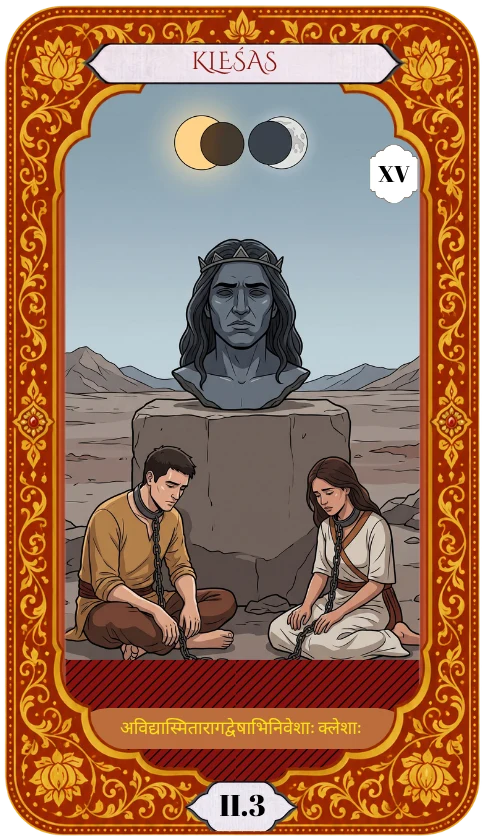
Kleśas (The Afflictions II.3)
Major Arcanum: The Devil
Kleśas (II.3) — ignorance, egoism, attachment, aversion and the fear of death.
The chains are loose. Name the affliction that holds you today: attachment, aversion or fear.
What Kleśas is
Kleśa comes from kliś: to squeeze, to afflict, to cause pain. The usual translation, affliction, is weak for what the word describes. This is not sadness. It is what tightens around you and bends what you see. A kleśa is not a flaw of yours and not a sin. It is a pattern that was already running when you arrived, and it works out of sight: it acts before you notice, then supplies a reasonable account of what it did. Someone being squeezed rarely knows it.
In the sutra
II.3 names five: avidyā, not seeing what is; asmitā, the identification with the idea you have of yourself; rāga, attachment; dveṣa, aversion; abhiniveśa, the clinging to life. The order is not random. Patañjali puts avidyā first because it is the ground the other four grow in — attachment and aversion grow on top of a mistake about what you are. Naming is where the work starts.
How it shows up
Kleśa picks for you before class begins: the time slot where nobody corrects you, the pose that already looks good, done three times over, the flash of anger at an adjustment that lasted two seconds. None of those three decisions went through your head. They arrived finished, reasons included. The mat becomes a stage, and then it is not practice: it is image maintenance.
Off the mat the grip is finer. You open the profile of someone you swear you are over. You reread the message you have not answered in three weeks and close the app again. You change the subject at the same point every time, whenever the conversation gets close. The chain that holds you is not thick. It is familiar, and that is enough.
Why this card
The Devil in the tarot has two small figures chained to the pedestal he stands on. Look at the chain: the collar is wide and would slip over a head without effort. Nobody is holding anything. They stay because they have grown used to being there, and because the large figure fills the whole field of view. A kleśa works the same way. What holds you has no strength of its own. It has habit, and your daily consent.
Today
There is something you repeat and do not defend out loud. Write down the sentence you use to justify it: the exact excuse, in your own words. Then read it as if someone else had written it. Do not try to change the behavior today. Seeing the excuse on paper already takes away half its job, which is to pass by unread.