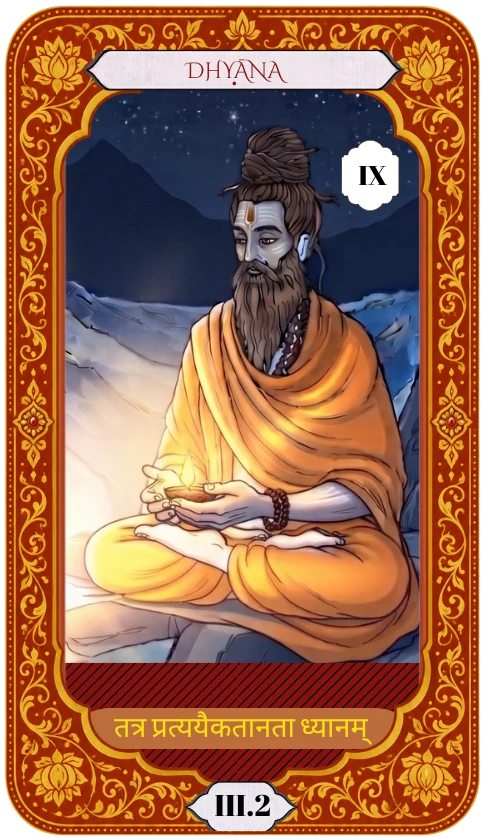
Dhyāna (Meditation III.2)
Major Arcanum: The Hermit
Dhyāna (III.2) — solitary meditation and unbroken attention.
Draw back into dhyāna, the attention that does not break off. Spend a few silent minutes today on one thing only.
What Dhyāna is
Think about water. A drop that falls, stops, falls again is one thing; a continuous thread is another. Dhyāna is the thread. The word is translated as meditation, which in everyday English covers almost anything, but in Yoga the sense is narrow: attention that does not break off, on one thing only. Before it comes the work of aiming the mind and aiming it again, which happens in drops. Dhyāna begins when putting it back is no longer needed.
In the sutra
III.2 is a short sentence, and that says something. Patañjali had already described the act of fixing the mind on one point; here he only adds the continuity, the same content, stretched out, with no cut. No visions, no special state. The test is tedious and honest: how long attention goes without changing the subject. That is why the chapter treats it as a stage, and not as a gift a few people have.
How it shows up
Sitting on the mat, the test is simple: count ten breaths without losing the number. Almost nobody gets there on the first try, and the useful part is not the failure, it is seeing where the mind went — always to the same two or three subjects. Dhyāna is not driving those out. It is not following them.
Away from the mat, measure something else: how long you can stand in line without taking the phone out of your pocket. For most people the answer is in seconds. Then think about last night. Forty minutes may have gone by on the screen with nothing left of it, the same forty minutes you swore, that morning, you did not have for sitting still.
Why this card
The Hermit walks alone, hood up, a staff in one hand and a lantern in the other. The lantern is small on purpose: it lights the next step, not the road. Anyone who meditates knows that size of light. The figure's solitude is not sadness either, and not escape, it is the working condition. With nobody to show it to, attention stops posing and stays with what it is doing.
Today
Set six minutes on a clock and sit in a chair with your feet on the floor. Stay with a single support: the air coming in through the nose, or one fixed point on the wall. When your head wanders off, come back without commenting. Do not count how many times it went. Today's work is only to finish the six minutes sitting.