Abhyāsa (Steady Practice I.13)
Major Arcanum: The Magician
Abhyāsa (I.13) — the constant effort to remain steady.
Use the tools you already have. Give a few minutes today to steady practice, with directed will.
What Abhyāsa is
Practice has a name of its own in Yoga: abhyāsa. The root carries the idea of applying yourself to the same thing, over and over, until it holds. It is not talent and not a good mood: it is the work itself — coming back, repeating, insisting without force. Patañjali sets abhyāsa beside vairāgya, the letting go, because effort with nothing released alongside it goes stiff. A three-year practice is not a special practice. It is the same practice, done a thousand times.
In the sutra
In I.13 Patañjali defines practice drily: the work of holding the ground you have already reached. Nothing in the definition mentions a result, a level or a quantity. The measure is staying. So practice is not judged by the inspired day but by the return on the day when nothing happens. Staying costs more than arriving, and it pays better.
How it shows up
In class, abhyāsa is the fourth sun salutation, not the first. It is repeating the same posture for six months and noticing in the seventh that the shoulder has moved. It is practicing with the body that woke up locked, without swapping the sequence just because it stopped being fun.
Outside class, the test comes in a full week. What you cut first when the day tightens shows what is actually a priority, and the first thing cut is usually the thing that does not chase you: nobody rings to ask why you did not practice. The bill adds up slowly — three months of "I'll pick it up again next week" and you are where you were last year.
Why this card
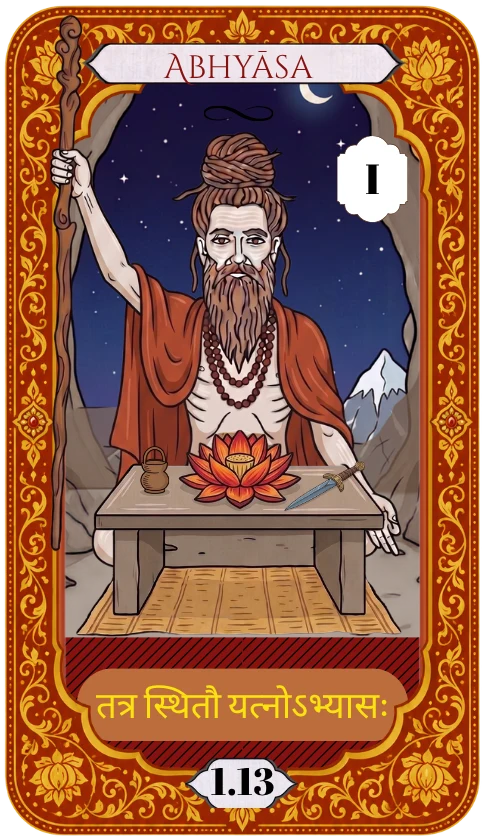
On the card, the Magician stands at a table with the four instruments on it: wand, cup, sword and coin. One hand points up, the other down. Nothing here is a trick; it is a trade. He knows where each tool sits because he has picked each one up a thousand times. What looks like power is old repetition, and that is why he comes first in the deck: the one who does the work.
Today
Pick a ten-minute practice and a time today. Write both down and leave the note where you will trip over it. When the hour comes, do it badly, in a bad mood, on a bad day. Tomorrow, at the same hour, do exactly the same. The repetition is the practice; wanting to do it is optional.