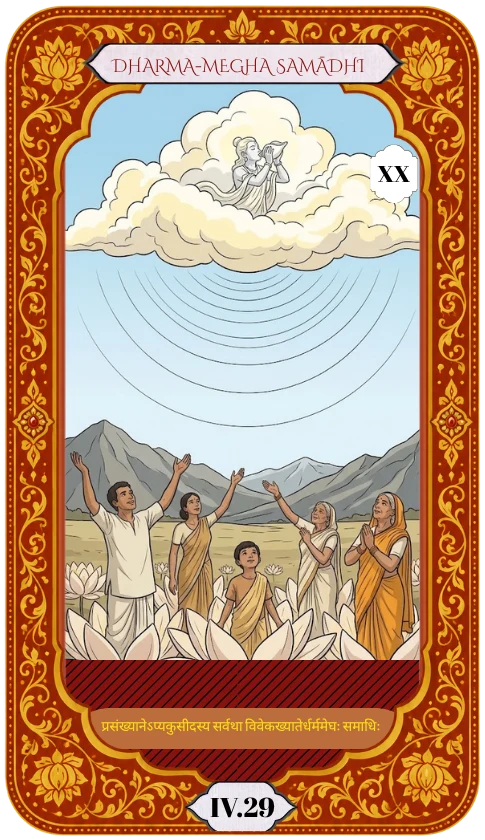
Dharma-megha samādhi (The Cloud of Dharma IV.29)
Major Arcanum: Judgement
Dharma-megha samādhi (IV.29) — the awakening that rains clarity over everything.
Listen to the call. Notice today how much you have already woken up, and be grateful for the road behind you.
What Dharma-megha samādhi is
Megha means cloud. Samādhi means absorption: attention that does not divide itself. The image is a loaded sky just before the rain breaks — what was scattered in the air gathers, grows heavy and falls. Dharma, here, carries the sense of ripened virtue, of what practice has piled up without you keeping score. Dharma-megha samādhi is that pile reaching the point where it spills over. It is not a prize for effort or a rank to earn: it is clarity that stopped being an exercise and became the weather.
In the sutra
The fourth book deals with the end of the path, and IV.29 sets an odd condition: the state comes to someone who has lost interest even in their own lucidity. No appetite for a reward, not even for the highest one. As long as clarity is something you collect, it is still property. Patañjali is saying that the last greed to go is spiritual greed, and that after it leaves, unbroken discernment does the rest.
How it shows up
In the room, this shows up as the absence of a scoreboard. Someone comes in, does what the day allows and leaves without comparing it to last week. No photo of the new posture, no counting of days in a row. The practice keeps happening, it just stopped paying out credit.
Outside the room, there is an invoice you issue in silence. You took your father to his appointment, covered a shift for a colleague, washed up dishes that were not yours — and then waited for someone to notice. The tab exists. It shows up in the line you keep for the next argument: “after everything I've done”. Dharma-megha starts where that tab stops being kept, including the spiritual tab of the person who has practiced longer than everyone else.
Why this card
Judgement shows figures rising out of coffins with their arms open, called by a trumpet. Look at what is missing from the scene: scales, a sentence, anyone being condemned. The name of the card misleads. The drawing is of people waking at the same moment, with everything they lived still in the body. Dharma-megha samādhi judges no one either: it recognizes what has ripened and lets it fall.
Today
Do one useful thing for someone today and tell nobody. Not in passing, not as a joke, not with the sideways comment that delivers the news without looking like it. Refill what was empty, pay what was due, fix the thing that was broken, and leave the room. The wish to be seen will arrive on its own; let it go by without answering it.