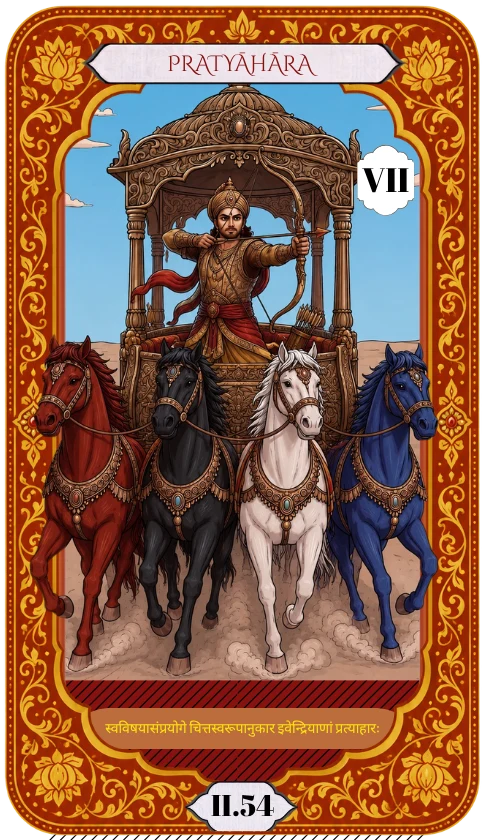
Pratyāhāra (The Withdrawal of the Senses II.54)
Major Arcanum: The Chariot
Pratyāhāra (II.54) — the senses withdraw as the mind withdraws.
Take hold of the reins of the senses. Spend a few minutes today with your eyes closed, with nothing coming in.
What Pratyāhāra is
Āhāra is food. Pratyāhāra is the food going back: the prefix reverses the movement. The senses eat all day long, the eye eats the screen, the ear eats the noise, and you do not even notice you are at the table. Pratyāhāra is the moment they stop chasing the plate and go back to following the mind. It is not plugging your ears. The sound carries on; what changes is that it stops pulling you.
In the sutra
The definition in II.54 has one curious word: imitate. Cut off from their own objects, the senses take to imitating the way the mind is, as if copying it. Patañjali puts this at the end of the outer part of the practice, just before attention turns inward. It is the hinge. No concentration begins while the senses are still working outward, each one pointing a different way.
How it shows up
On the mat, the test is śavāsana, the lying-down rest at the end. Eyes closed, body still, and attention goes out the window after a passing motorbike, the neighbor breathing loudly, the second hand on the clock. Withdrawing is not fighting the noise: it is noticing that you left, and coming back to your own weight on the floor. The mirror does the same thing more politely: you end up watching the posture instead of feeling it.
Think about your last lunch. If it happened with your phone in your hand, you cannot say what the food tasted like, only that the plate is empty. Then there is the way home: some days you arrive with no memory of the trip. Your body went, you did not. And there is the hand that reaches for the phone before you decide to reach for it.
Why this card
In the Marseille deck, the Chariot has a driver standing upright, a crown on his head, a scepter in his hand, and two horses looking in opposite directions. No reins are drawn anywhere in the image. The vehicle moves because the one standing above is not dragged by either horse. Older Indian texts already used horses to talk about the senses, and the card repeats the idea: driving, not fighting.
Today
Pick a dull five-minute chore: folding laundry, watering the plants, sweeping one room. Do it with the sound off and the phone left somewhere else. While you are at it, stay with one sense only — the weight of the cloth, the smell of the wet soil. When attention slips away, do not argue with it: bring it back and finish the job.