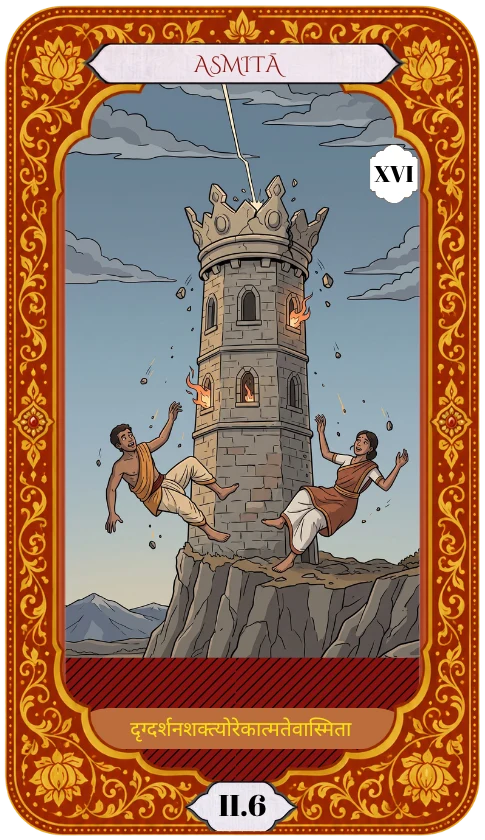
Asmitā (The Fall of the Ego II.6)
Major Arcanum: The Tower
Asmitā (II.6) — the ego is born of confusing the seer with the instrument of seeing.
What falls was illusion. If something comes down today, treat it as a chance to drop a false identification.
What Asmitā is
Asmi means “I am”. Add -tā, the Sanskrit ending that turns anything into a noun, and you have asmitā: the state of being me. It shows up as the feeling of being someone, and not just anyone: the boss, the eldest child, the one who fixes the family's problems. Having a role is not the problem. Forgetting that it is a role is. Asmitā is when the description sticks to your skin and you start defending the description as though it were your life. It is one of the kleśas, the afflictions that blur what you perceive.
In the sutra
The second book takes the afflictions one at a time, and in II.6 asmitā is described as the mixing up of the one who observes with what is observed. What sees is not what appears. You are not the job title, not the body that ages, not the opinion you defended yesterday. The sutra does not ask you to give any of it up. It points only at the confusion: taking the instrument for its owner.
How it shows up
The block you will not reach for, because blocks are for beginners: asmitā fits inside that small detail. It is also in taking the harder variation on a day your body asked for rest, in always claiming the same row, in being “the flexible one in the class” and treating a bad day as a personal insult.
Out in the world, the test arrives as criticism of your work. Within two seconds the conversation stops being about the work and becomes about you. It is also why so many people defend an opinion to the end long after they stopped holding it: backing down does not cost you the argument, it costs you the face of someone who is never wrong.
Why this card
The Tower in the tarot is struck by lightning, and the first thing you see falling is the crown at the top, along with the two figures. Notice what the drawing leaves out: nobody is dying. The building comes down, and so does the ornament that marked who gave the orders there. Asmitā is exactly that ornament. The card is the noise of an identity collapsing, and the discovery that there was someone underneath it.
Today
The next time you introduce yourself today, say only your name. No job, no years of experience, nothing you have done. Watch how long the conversation survives without that prop, and watch the urge to fill the gap. This is not modesty. It is a test of whether anyone is left once the business card is out of the way.